

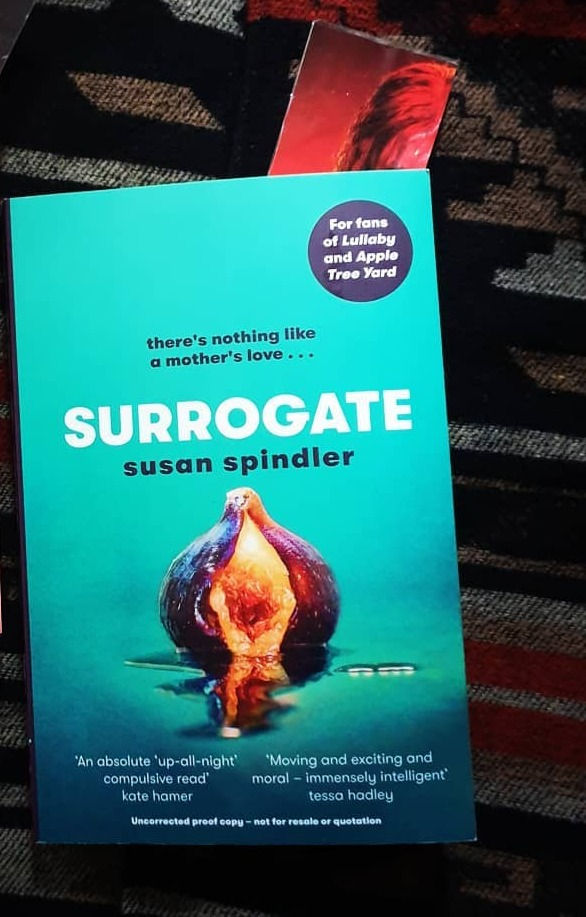
Surrogate Review
- portuguelo
- Apr 1, 2021
- 4 min read

"Surrogate" invites us into the world of IVF, surrogacy and motherhood through the eyes of the Furnival family: Ruth the postmenopausal matriarch and her daughter Lauren who tries to look past her insecurities and reservations with her mother in order to finally have a baby. But can Ruth be trusted?
General Impressions
This is what happens when rich people don't get therapy!
"Surrogate" is not a cute little book about a grandmother's selfless act to be a surrogate to her grandchild. It's about the complexities of womanhood and motherhood in a society that shames women for embracing their sexuality and choosing to be childless, punishes them for having children and then forgets them once they get past forty.
This book was so good and left me so angry. Every character was so wonderfully complex, flawed and taken to their very limit and then some. Even the characters I hate, I understand why they are the way they are and made the decisions they did. "Surrogate" is a very nuanced piece of fiction but I can't help but think that would be even more impactful as horror, if more difficult to market to its target audience, perhaps. I would read/listen/binge-watch the crap out of it though.

The most surprising part for me, and I think it goes to show Susan Spindler's research skills was how dirty and money-grabbing the IVF and surrogacy businesses were and the monetary and emotional devastation they leave behind them when they fail to work. That and how it's a business that aims primarily not to get sued. Much of its legislation reflects that instead of their concern for the patients.
Although women are usually the ones that suffer the most physically and emotionally through the treatments, I was always looking forward to any chapter told through Adam and Dan's eyes, because it's rare to see a man at the centre of such conversation as a father rather than beside the wife as just a secondary concern or the antagonist to the story in some way.
Ruth and Adam
Ruth and Adam are the seemingly in love middle-class empty nesters. They go on dates and holidays and are supportive and involved with their children's and partners lives. It doesn't take many chapters to realise that is only a facade.
Ruth often speaks and is praised for the way she was able to "have it all": a career, a husband and children. She was able to do that because Ruth was not a mother. She was a father.

Even as a middle-class family able to hire people to care for their children, one parent still had to make sacrifices in their career to make sure the children had someone at home, and that someone was Adam. Not only that was never addressed by anyone other than Adam himself, those sacrifices had consequences: Ruth was able to advance her career and become the breadwinner and then hold that over his head in order to justify her every disgusting act. (*More about this at the end if you don't mind spoilers).
Ruth is a manipulative, lying, abusive piece of trash and the way she was allowed to keep going without any consequences or public banishment is only possible for rich white women. The only long-lasting consequence she faces is being forced to get old, the same as everyone else. What a tragedy!! If the genders were reversed, this would be the tale of thirty years of domestic violence. As it was, she never even apologized with any remorse, only as a way to manipulate people into the place she wanted them once again.
Lauren and Dan
Lauren and Dan's marriage is a very stark contrast to the previous one. Ruth sees her husband and marriage as the same as everything else: something to be managed, lied and coddled as necessary for her to get the desired ending.
Lauren and Dan's marriage, on the other hand, is a partnership, where the other's feelings and thoughts are considered and they argue and talk about what is going on and what is bothering them.
Thanks to the people around him and also, I believe to his generation, Dan is seen more as a person and not just "the husband" and that is clear in the way Adam and Dan interact with the people around them. The only exception is when Ruth has power over the couple and is able to steer them away but even that doesn't last long.

Conclusions
If you are looking for a great story in which incredibly complex characters are taken to their very limit look no further. "Surrogate" is a great examination of what parenthood can mean to different people and the way our own childhood and parents can affect us when hurts and traumas are brushed aside and left to fester.
Thank you to Virago Press and Little, Brown Books for sending me this proof.
Rating: 4/5


*Bodily Autonomy (with spoilers)
When you write a book about pregnancy, fertility and womanhood, the theme of bodily autonomy will at least be between the lines. Susan Spindler chose not to be a coward and put it at the forefront of every discussion: abortion, fertility treatments, pregnancy, surgery...
While I'm really mad that Ruth wasn't punished at all for all the awful criminal things she did throughout this book, I was at least glad she wasn't killed in the middle of labour for the "crime" of having had an abortion when she was young. But neither that nor her awful childhood are excuses for the person she became and she should have ended alone and shunned by everyone for being a domestic abuser.
Ruth physically assaulted her husband once she found out he had had a vasectomy after she tried to get pregnant against his will, she became a surrogate without his knowledge, forged his signature and when for the first time she had to suffer consequences for her behaviour and Adam moved out of the house, she lied and maligned him to their daughters in order to isolate him and force him to return to her (after she slept with someone else). And still, the book ends with the family celebrating her birthday and never talking about her actions ever again. Could you find a more WASPish family?


Comments