

A Master of Djinn Review
- portuguelo
- Aug 25, 2021
- 4 min read
OH. MY. GOD!!!!! This! This! This! My world was never the same after this book!
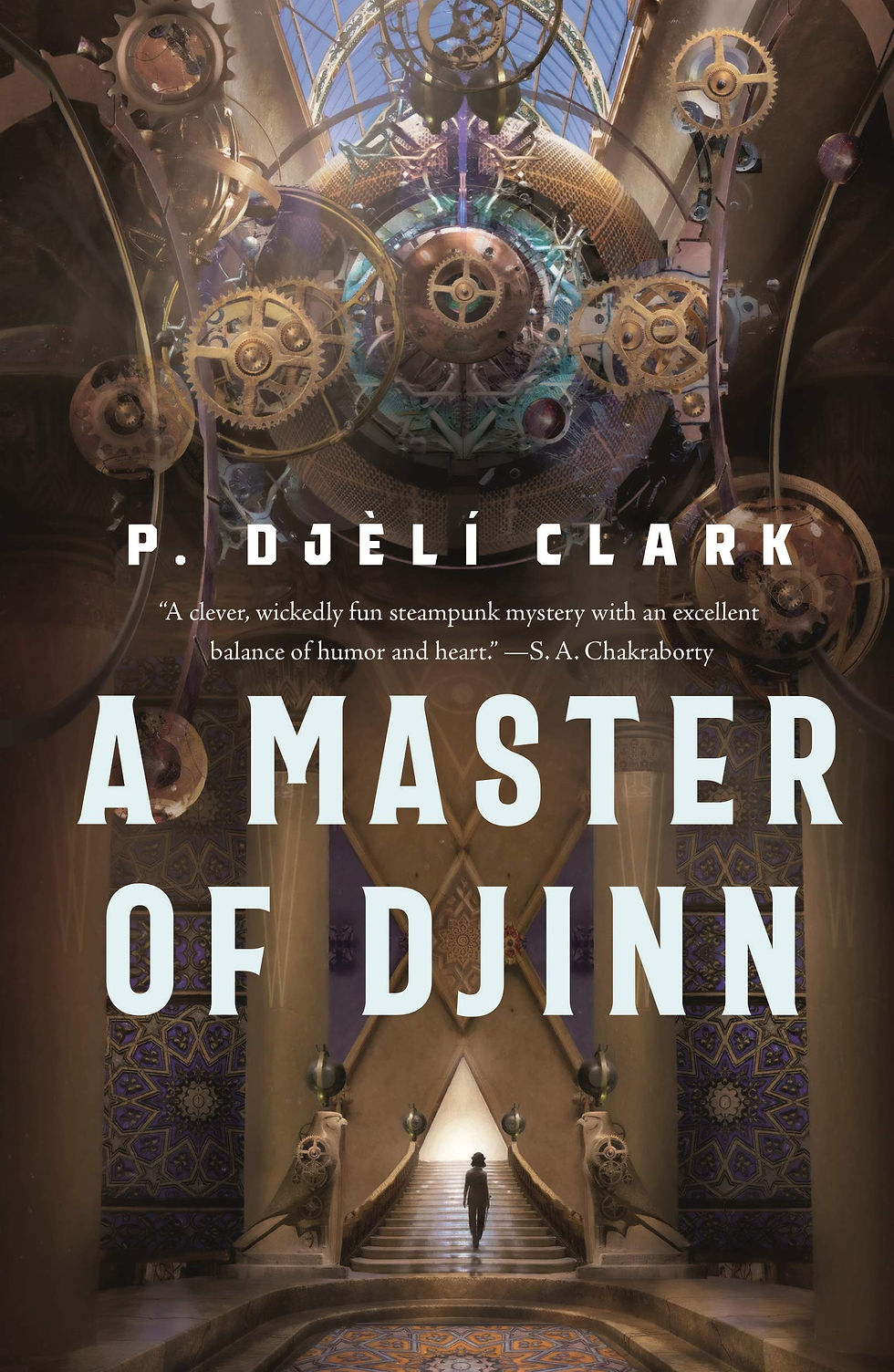
Nebula, Locus, and Alex Award-winner P. Djèlí Clark returns to his popular alternate Cairo universe for his fantasy novel debut, A Master of Djinn
Cairo, 1912: Though Fatma el-Sha’arawi is the youngest woman working for the Ministry of Alchemy, Enchantments and Supernatural Entities, she’s certainly not a rookie, especially after preventing the destruction of the universe last summer.
So when someone murders a secret brotherhood dedicated to one of the most famous men in history, al-Jahiz, Agent Fatma is called onto the case. Al-Jahiz transformed the world 50 years ago when he opened up the veil between the magical and mundane realms, before vanishing into the unknown. This murderer claims to be al-Jahiz, returned to condemn the modern age for its social oppressions. His dangerous magical abilities instigate unrest in the streets of Cairo that threaten to spill over onto the global stage.
Alongside her Ministry colleagues and her clever girlfriend Siti, Agent Fatma must unravel the mystery behind this imposter to restore peace to the city - or face the possibility he could be exactly who he seems....
General Impressions
You've never read anything like this, no one has ever read anything like this. Gods I'm in paradise!!!!
"A Master of Djinn" is set in a 1912 alternative world where magic runs free and Egypt is once again a world power thanks to the richness and vastness of their mythology. The magic system and world-building are groundbreaking by themselves but the fact that this was written by a POC author with a majority of POC characters from diverse backgrounds and all kinds of life experiences and identities was the cherry on top of the cake.
There are so many great characters in this book but I want to focus on two: Fatma and Hadia.
Fatma, the main character of the book, is one of the best agents in the Ministry of Alchemy, Enchantments and Supernatural Entities. But there is more than her talent or great fashion sense (our woman has the best suits in the land!) that separates her from the people around her because Fatma had to cross a lot of obvious and not so obvious hurdles from being born in a small town, to be one of the first women working as a government agent to being a Muslim woman that is queer.
Fatma's and Siti's romance was one of the most beautiful and consensual relationships I have read in a while. They love and respect each other through the good and bad without ever forgetting themselves. Theirs is an inter-racial, inter-faith, closeted relationship and those are not small things brushed under the rug but addressed throughout the entire book.
Hadia, Fatma's recently and not so wanted Ministry-appointed apprentice on the other hand seems at first glance to be a more conservative Muslim woman, but if that is all you see her as, that's your own problem. Hadia is the most awesome observant Muslim (possibly ninja) character I have ever read and I NEED more of her! While Fatma wears most of her differences loud and proud and refuses to give explanations to anyone, Hadia chooses instead to help change the world not only be existing and persevering even when she is told point-blank that as a woman she should be home but by speaking up not only for herself but for those who can't. Hadia uses her privilege and faith to educate others but when presented with a new situation, is able to change her viewpoint or behaviour in order not to become the oppressor. I adore her with everything I have.

I honestly could not predict what would happen on the next page much less how this book would end and that was such an addictive experience. I both flew through every page and had to stop every few minutes to google all kinds of terms from Arabic religious terms to food to architecture to Ancient African to more recent history. This is a book that fills you up and leaves you HUNGRY at me at the same time. I learnt so much about Egyptian culture just by reading it.
There are so many big and impressive moments and monologues throughout the book and yet what made me laugh and hug the book to my chest was this small chapter where Fatma and Siti meet some with some of their expatriate American friends running away from Jim Crow in an underground bar and drink, laugh and dance to the sound of jazz. That little place where people used to be outlawed and demonized are free not only to exist but be loud and happy just made my queer heart so damn JOYOUS. I knew and every queer, POC, discriminated against reader in the world knew what those characters felt because we've been there and we know how it feels to find a space where you can finally breathe and be.
Conclusions
P. Djeli Clark was able to not only built an amazing original world but addressed religious diversity and intolerance, racism and colourism, colonialism (this was the second time I saw 'colonialist' as an insult and I loved it!) without making it feel forced or out of place. There were great stakes balanced with romance and humour and I loved how sapphic it was. I'm now going to devour every short story and author's interview until there's news about a sequel.
Thank you, thank you, thank you to Orbit for sending me this proof.
Rating: 5/5




Comments